How Automotive Designers Use AI for Concept Ideation.
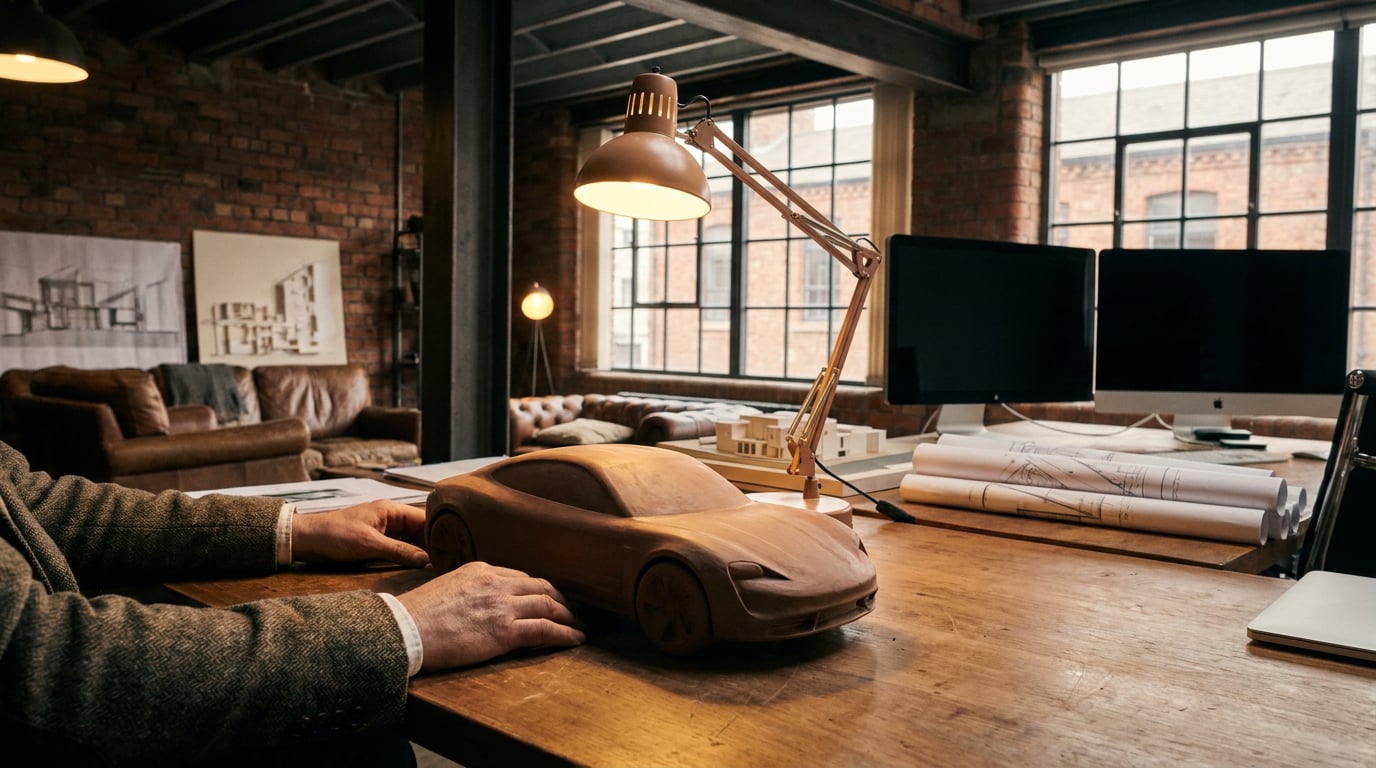
Automotive designers are using AI to compress concept cycles and explore more visual territory before a single clay model is cut.
Where the Automotive Concept Process Actually Slows Down

The bottleneck in automotive concept work is rarely talent. Designers working at OEM studios and specialist agencies carry strong instincts about proportion, stance, and surface character. The problem is the gap between a mental image and a shareable artefact that stakeholders can actually react to.
Sketching is fast. Rendering is not. A designer can fill a page with proportional studies in an hour, but translating the most promising sketch into something a brand director or engineering lead can evaluate typically requires a competent renderer, specialist software, or a full working day of personal effort. By that point, the creative momentum has stalled and the brief has moved on.
Brief interpretation adds a second stall point. Translating a vehicle programme brief, covering segment positioning, character language, target buyer profile, and competitive context, into a coherent visual direction requires research time that most teams compress badly. The research happens informally, in the margins, and the resulting moodboard is assembled the night before the first review rather than before the first sketch.
Kia's Global Design team has described exactly this pattern in their own account of adopting generative AI tools. Their approach uses AI to speed up the conceptual phase by turning a sketch plus directional keywords into multiple candidate images, allowing designers to "sketch tons of images" faster and validate ideas sooner. Critically, Kia frames this as addressing a few parts of the workflow, not replacing it. The instinct still belongs to the designer. What AI compresses is the time between instinct and artefact, and that is where most hours are lost.
The slowdown in automotive concept work is not between thinking and sketching. It is between sketching and the first image another person can critique.
Using Moodboards and Research to Lock in a Visual Direction

Before a single generative image is produced, automotive designers need a coherent reference world. Surface language, material palette, environmental context, and competitive positioning all need to be agreed before ideation begins. Without that alignment, AI image generation produces aesthetically competent but directionless output that burns review cycles without building towards anything.
Stensyl's Moodboards surface lets designers pull visual references into a shared board, separating inspiration from imitation before the creative phase begins. The discipline matters: a moodboard that conflates three different surface languages will produce three different generative directions, none of which fully satisfies the brief.
The Research surface, backed by Perplexity, helps designers interrogate a brief quickly without leaving the platform. Segment trends, regional colour preferences, material culture signals, and competitor positioning can all be surfaced in the same workspace where the moodboard is being built. A designer working on a compact electric crossover for a European market can pull competitor exterior language, current CMF trends in that segment, and buyer lifestyle reference in a single session rather than across three browser tabs and a shared folder.
A strong moodboard does something specific in automotive ideation: it constrains the generative phase productively. Kia's designers described specifying keywords such as "bold," "dynamic," or "sporty" alongside uploaded sketches and reference images, using those constraints to steer AI outputs rather than simply prompting from nothing. That steering is much more reliable when the reference world has been explicitly built in advance.
Teams working across studios or with external stakeholders can share project moodboards via Projects, keeping the visual brief aligned before a single prompt is written. The brief, the references, and the generated work live in one shared workspace rather than in separate applications that require manual synchronisation before each review.
Generating and Iterating on Concept Visuals
Stensyl's Generate surface is where broad automotive ideation happens. Designers can explore proportions, stance, greenhouse shapes, and surface character across many variations quickly, testing directional hypotheses that would take days to evaluate through traditional rendering. Faculty at transportation design programmes have noted that AI tools can move teams from sketching to refinement in "days or even hours," and that a 3D model can be derived from a single side-view drawing plus one reference point, then rotated and corrected without a full modelling session.
The 3D surface adds a further dimension to this process. Generating base meshes or retexturing surfaces lets designers test material and colour language on rough volumetric forms before committing to detailed modelling. CMF exploration, which has historically required either a physical mock-up or a fully dressed 3D model, can happen much earlier in the concept phase when basic volumetric forms are generated and retextured quickly.
Canvas, Stensyl's node-based workflow editor, is where iteration becomes systematic rather than repetitive. A designer can pipe a base concept image through multiple generation nodes, applying lighting changes, material swaps, or background environments without rebuilding each prompt from scratch. The same exterior study can be evaluated in a city environment, a motorway environment, and a studio lighting condition inside a single Canvas workflow, producing consistent comparison sets that are far more useful in review than individually generated images with inconsistent parameters.
Ray, Stensyl's creative-decision assistant, helps designers choose the right generation model for the task at hand. Photorealistic exterior renders require different model choices than loose ideation sketches or CMF explorations, and Ray's role is to surface that distinction before credits are spent on the wrong approach. It is locked to a fast Anthropic Haiku model and is built for quick directional guidance rather than extended creative dialogue.
Generating thirty proportional studies in a morning is a qualitatively different creative process than refining three hand sketches. Volume enables a kind of systematic exploration that hand work simply cannot match at that speed.
Variation volume matters specifically in automotive design because the discipline is acutely sensitive to proportion. Small shifts in greenhouse height, wheel-arch proportion, or bonnet length produce dramatically different characters. MIT Sloan's coverage of GM-linked research describes a generative model that creates new car designs from prompts covering viewpoint, colour, body type, and reference image, paired with a predictive model that forecasts consumer ratings for appeal and innovativeness. The research frames these as tools for designers to work with, not autonomous systems that replace designer input. The human designer still sets the parameters; the AI produces the candidate variations.
Writing Briefs, Narratives, and Presentation Copy
Automotive concept presentations are not purely visual. They carry a design narrative: the vehicle's character, its intended owner, its emotional positioning, and the design decisions that connect all three. That copy takes time that most designers do not budget for, and it typically gets written under deadline pressure by someone whose primary skill is visual rather than verbal.
Stensyl's Write surface supports long-form drafting with a multi-model picker. Designers on the Starter tier can use GPT-5.5 or Gemini Pro to draft concept statements, naming rationales, or press-facing narratives directly alongside their visual work. The ability to write in the same workspace where the research and moodboards live means the narrative is grounded in the same reference world as the visual output, rather than being invented separately and bolted on.
Pro tier users can access Claude Sonnet 4.6 or Claude Opus 4.7 for more nuanced narrative writing. This is particularly useful when the concept has a complex cultural or emotional brief: a vehicle positioned around a specific regional identity, a heritage brand extension that requires careful tonal calibration, or a concept that needs to sit simultaneously in a sustainability narrative and a performance narrative without contradiction. Claude's handling of layered tonal requirements makes it well suited to exactly those briefs.
Having the brief, research, visual references, generated images, and narrative inside one project means the presentation does not have to be reconstructed from five separate applications at deadline. The writing model in Canvas's LLM Chat node can also be used mid-workflow to generate descriptive copy for individual views or generate section headers for a presentation deck, keeping the verbal and visual work integrated throughout the process rather than separated by phase.
| Tier | Monthly Credits | Concurrent Generations | Write Models Available |
|---|---|---|---|
| Lite (£10/mo) | 1,000 | 1 | GPT-5.4 mini, Gemini Flash |
| Starter (£22/mo) | 2,500 | 1 | + Gemini Pro, GPT-5.5 |
| Pro (£42/mo) | 6,000 | 2 | + Claude Sonnet 4.6, Claude Opus 4.7 |
| Studio (£84/mo) | 12,500 | 4 | All models |
Structuring a Repeatable Concept Workflow

A repeatable workflow matters more than a brilliant one-off. Automotive designers working in agencies or OEM studios need processes that hold up across briefs, not heroic individual sprints that cannot be reconstructed or handed to a collaborator.
A practical structure using Stensyl's surfaces looks like this:
- Research and brief definition: Use the Research surface to interrogate the brief quickly. Segment trends, competitive positioning, regional market signals. Pull findings directly into the project.
- Visual direction: Build a Moodboard that establishes surface language, material palette, and environmental context before any generation begins. Share it with team members via Projects for alignment.
- Broad ideation: Use Generate to explore proportional variations, stance studies, and greenhouse options at volume. Use Ray to select the right generation model before spending credits.
- Volumetric testing: Use the 3D surface to test CMF variations on rough volumetric forms. This happens earlier in the process than traditional modelling timelines would allow.
- Systematic iteration: Build a Canvas workflow for the most promising direction. Pipe base images through lighting, material, and environment nodes. The same workflow can be adapted for the next brief.
- Narrative and presentation: Use Write to draft the concept statement, design narrative, and any press or stakeholder copy. Keep it inside the same project as the visuals.
Projects keeps everything together. Brand identity assets, reference boards, generated images, and written narratives live in one shared workspace rather than scattered across drives and email threads. When the design director asks for a revised direction mid-project, the full context is in one place rather than requiring a manual reconstruction from multiple sources.
Canvas workflows can be saved and reused. A lighting-and-background node setup that works for one exterior brief can be adapted for the next without rebuilding from scratch. Over several projects, a studio builds a library of workflow templates calibrated to their most common brief types.
Credit management matters at scale. Designers running heavy generation sessions should plan their tier accordingly. Pro gives 6,000 credits per month with two concurrent generations, which suits a single designer running parallel concept streams. Studio gives 12,500 credits with four concurrent generations, which is better suited to small teams working on multiple briefs simultaneously or a single project with a heavy ideation phase.
The difference between a useful AI integration and a frustrating one is a repeatable structure. When the workflow is documented and the surfaces are used in sequence, the speed gains compound across every brief rather than appearing once and being lost.
What AI Cannot Do in Automotive Design
AI generation does not understand engineering constraints. A generated image may show a surface that is visually compelling and proportionally convincing at a glance, but physically impossible to manufacture, structurally incoherent, or incompatible with the platform packaging that a real vehicle programme requires. A striking roofline that tapers aggressively may work beautifully as a rendering and fail completely once occupant headroom is mapped against it.
MIT Sloan's coverage of the GM-linked generative design research is explicit on this point: the human designer must define the parameters, and the AI proposes candidates within them. The system does not understand what makes a design manufacturable or what constraints govern a particular vehicle platform. It generates visually plausible variations. Evaluating whether those variations are actually viable remains entirely the designer's responsibility.
Proportional plausibility is a trained eye's job. AI models trained on broad image datasets will produce vehicles that look convincing at thumbnail scale and fail basic package scrutiny when reviewed carefully. Wheel-arch proportions that look dynamic in a generated image may imply tyre diameters that do not exist. A greenhouse profile that reads as elegant may compress headroom to a point that no production vehicle could accept. These failures are not obvious to a non-specialist reviewer, which means the designer's critical evaluation role becomes more important, not less.
WardsAuto's reporting frames this accurately: AI accelerates ideation and bridges sketch to presentation, but it does not replace the validation phase. Transportation design faculty quoted in the same coverage describe the technology as moving teams faster through the early conceptual phase, not through the engineering and feasibility phases that follow.
The best automotive designers using AI report faster exploration but similar or longer evaluation phases. More options on the table requires more rigorous selection criteria, not less. A designer who generates thirty proportional studies must still apply the same trained scrutiny to selecting among them that they would apply to three hand sketches. The difference is that thirty studies surface proportional territory that three would never reach, which is where the genuine creative value of the tool lies.
This pattern holds across disciplines. Furniture designers using generative tools for early form exploration, product designers testing colourway variations before CMF reviews, and graphic designers generating layout candidates before refinement all face the same fundamental dynamic. The AI produces volume. The professional provides judgement. Neither works without the other.
The designer's role shifts rather than shrinks: less time on production of early-stage visuals, more time on critical evaluation of what the AI produces and on the directional decisions that follow. That is a meaningful shift in how the working day is structured, but it is not a reduction in the complexity or value of the designer's contribution. It is a reallocation of attention towards the parts of the job that are hardest to accelerate and that matter most to the outcome.
```Keep reading.

Try Stensyl for yourself
Image, video, 3D, chat, and document drafting. Every AI model, one studio. Plans from $11/month.